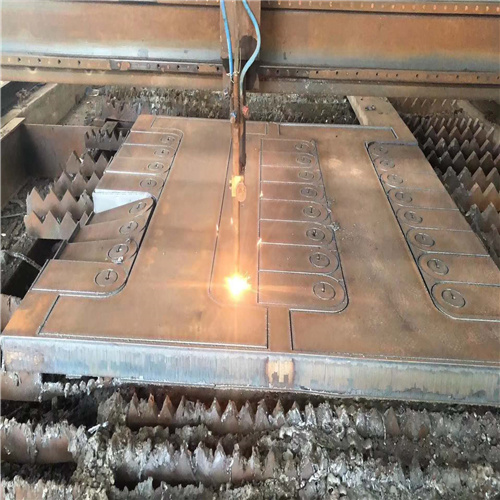
Oxy-Fuel Cutting Process for S355JR Steel Plate
Material Standard: EN 10025-2 S355JR low-alloy high-strength structural steel, carbon equivalent CE ≤ 0.47. Suitable for oxy-fuel cutting. Thick plates have risks of hardened cut edges and delayed cold cracks. Equivalent domestic reference grade: Q355B; Oxy-fuel cutting is abbreviated as OFC.
1. Preparations
1.1 Plate Surface Requirements
- Remove scale, rust, oil, paint and accumulated water within cutting area. Moist surface increases cracking risk on cut edges.
- Support the steel plate steadily and reserve space for slag dropping to avoid slag adhesion and slag blockage at plate bottom.
- Oxygen purity shall be ≥99.5%. Insufficient oxygen purity leads to rough cut surfaces and heavy dross adhesion.
1.2 Cutting Nozzle & Flame Requirements
- Flame type: Neutral flame (Carburizing flame and oxidizing flame are strictly prohibited) with distinct bright blue inner cone.
- Nozzle height: 6~10 mm; 6~8 mm for thin plate, 8~10 mm for thick plate.
- Torch posture: Tilt the nozzle backward by 10°~20° for thin plates; keep vertical for plates ≥40 mm thick.
1.3 Preheating Specification (Key Measure to Prevent Cracks)
A hardened layer will form in the heat-affected zone after oxy-fuel cutting of S355JR. Delayed cracks may occur on thick plates (appear within several hours to 48 hours after cutting).
| Plate Thickness t |
Preheating Requirements |
| t ≤25 mm |
Cutting at ambient temperature, preheating is generally unnecessary. Preheat locally to 80~100 ℃ under low ambient temperature (<5 ℃). |
| 25 mm < t ≤50 mm |
Preheat the range at least 75 mm on both sides of cutting line to 100~120 ℃. |
| t>50 mm |
Preheat to 120~150 ℃. Avoid concentrated local overheating. |
Temperature measurement: Use temperature indicating pen or infrared thermometer. Ensure uniform preheating instead of surface-only heating.
2. Recommended Process Parameters (CNC Cutting Machine, Two Options: Acetylene / Propane)
Option A: Oxygen + Acetylene (Widely Used)
| Plate Thickness (mm) |
Nozzle Model |
Preheat Oxygen Pressure (MPa) |
Acetylene Pressure (MPa) |
Cutting Oxygen Pressure (MPa) |
Cutting Speed (mm/min) |
Reference Kerf Width (mm) |
| 6~12 |
No.1 |
0.03~0.04 |
0.02~0.03 |
0.30~0.40 |
350~450 |
1.8~2.2 |
| 12~25 |
No.2 |
0.04~0.05 |
0.025~0.035 |
0.40~0.55 |
280~360 |
2.2~2.6 |
| 25~50 |
No.3 |
0.05~0.06 |
0.03~0.04 |
0.55~0.70 |
200~280 |
2.6~3.2 |
| 50~100 |
No.4 |
0.06~0.08 |
0.035~0.05 |
0.70~0.90 |
120~200 |
3.2~4.0 |
| 100~160 |
No.5 |
0.08~0.10 |
0.04~0.06 |
0.90~1.10 |
80~120 |
4.0~5.0 |
Option B: Oxygen + Propane (Lower Cost, Commonly Used in Factories)
Propane working pressure is generally higher than acetylene
| Plate Thickness (mm) |
Preheat Oxygen (MPa) |
Propane (MPa) |
Cutting Oxygen (MPa) |
Cutting Speed (mm/min) |
| 10~30 |
0.04~0.06 |
0.06~0.09 |
0.45~0.60 |
240~320 |
| 30~60 |
0.06~0.08 |
0.08~0.12 |
0.60~0.80 |
160~240 |
| 60~120 |
0.08~0.11 |
0.10~0.15 |
0.80~1.10 |
90~160 |
Important note: Do not set excessive cutting speed. High speed easily causes bottom dross and microcracks on cut edges. Reduce speed appropriately for thick plates.
3. Standard Operating Procedure
- Equipment Inspection: Check pipeline for gas leakage; confirm flashback arrestors are intact; assemble matched nozzle according to plate thickness.
- Ignition and flame adjustment: Ignite after opening fuel gas, slowly turn on preheating oxygen, and adjust to standard neutral flame.
- Preheating & Cutting Start
- Edge start: Preheat the starting point to bright cherry-red (~900 ℃ ignition temperature), then slowly switch on cutting oxygen.
- Internal piercing: Extend preheating time, pierce slowly with low flow cutting oxygen to prevent molten slag splashing and nozzle clogging.
- Continuous cutting: Move forward at constant speed and keep stable nozzle height. Continuous ejection of oxidized slag at plate bottom indicates full penetration.
- Cutting termination: After full separation of workpiece, keep moving for another 5~10 mm with cutting oxygen open. Close cutting oxygen first, then preheating fuel gas.
- Cooling control after cutting ✅ For plates thicker than 30 mm, forced water cooling is forbidden! Rapid cooling greatly increases hardening and cracking risk. Cool naturally in air.
4. Cut Quality Control & Solutions for Common Defects
4.1 Heat-Affected Zone & Hardened Layer
A hardened layer will form on the cutting surface after oxy-fuel cutting. For subsequent processing:
- Machining: Set machining allowance ≥2~3 mm to completely remove the hardened layer.
- Direct welding: Grind off oxide scale and microcracks, and adopt preheating matching S355JR welding procedure.
4.2 Typical Defects
- Cut edge cracks (delayed cracks) Causes: No preheating for thick plates, excessive cutting speed, forced cooling after cutting, high carbon equivalent of raw material. Solutions: Implement preheating requirement, reduce cutting speed, adopt natural cooling. Inspect cut edges for cracks within 48 hours after cutting.
- Bottom dross & incomplete penetration Causes: Insufficient oxygen purity, low pressure, clogged nozzle, excessive cutting speed, carburizing flame. Solutions: Clean nozzle, increase oxygen pressure, moderately lower travel speed.
- Top edge melting & excessive rounded corner Causes: Excessively strong preheating flame, too low cutting speed. Solutions: Reduce preheating flame power and properly raise cutting speed.
5. Additional Requirements for Bevel Cutting (If Welding Bevel Required)
- Common bevel angle: 30°~45°. One-step forming by CNC cutting.
- Avoid severe ablation on bevel surface. Bevel cutting shall comply with the same preheating requirements.
- Grind off oxide slag and microcracks on bevel surface after cutting before welding.
6. Safety Requirements
- Keep away from combustibles and place fire extinguishers on site.
- Flashback arrestors must be installed. Close fuel valve immediately once flashback occurs.
- Ensure good ventilation; wear face shield and flame-resistant work clothes.
- Prevent pipelines from extrusion and direct sunlight exposure.
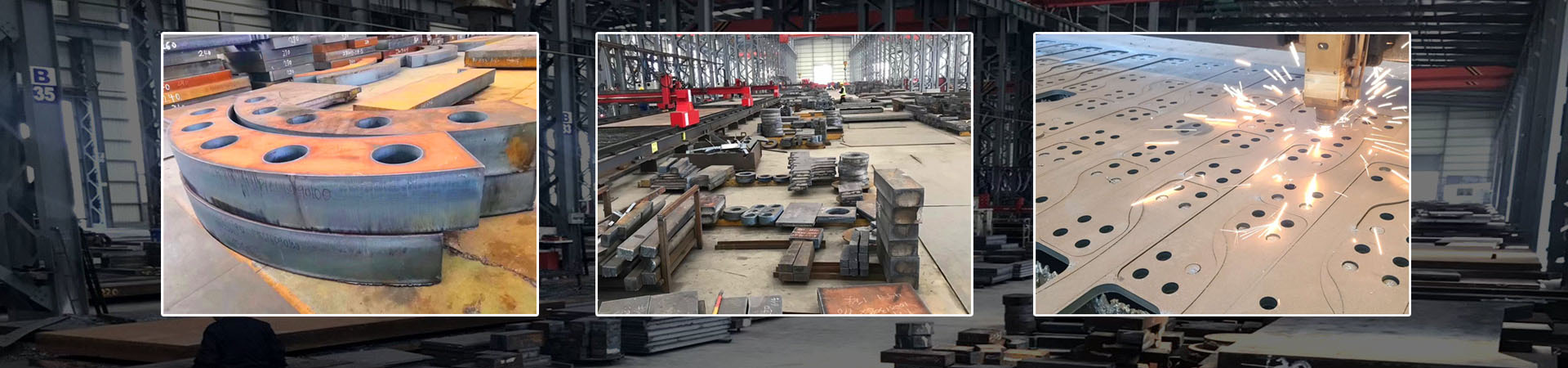
Cutting processing: wear-resistant steel plates (NM360/NM400/NM450/NM500/Mn13), high-strength plates (Q690D/E/S690Q/QL), ordinary plates (Q235B/S235JR), low alloy plates (Q355B/C/D/E/S355JR/J0/J2/K2), carbon bonded plates (45 #, S45C, S50C, bm48c), as well as various special alloy steels from large steel mills such as Wuhan Iron and Steel Group, Liangang, Baosteel, Ansteel, Shagang, Nangang, Hanye, Xingcheng, Yingkou, Ma Steel, etc., as well as Tang Steel, Wenfeng, Ping Steel, etc. The specification is 6MM-500MM thick.
We have good business channels with major steel mills and undertake various types of steel plate OEM processing business. The processing center can cut various supporting materials for engineering machinery, metallurgical equipment, mining machinery, etc. according to customer requirements, such as square plates, circular cakes, flanges, machine side plates, irregular parts, bearing support seats, etc., and process various irregular parts, support seats, machine tool side plates, metallurgical mines, and other supporting materials